How a patch of turbulence spreads
A localized blob of 2D turbulence spreads slower than diffusion — and how slowly turns out to be a fingerprint of its own structure.
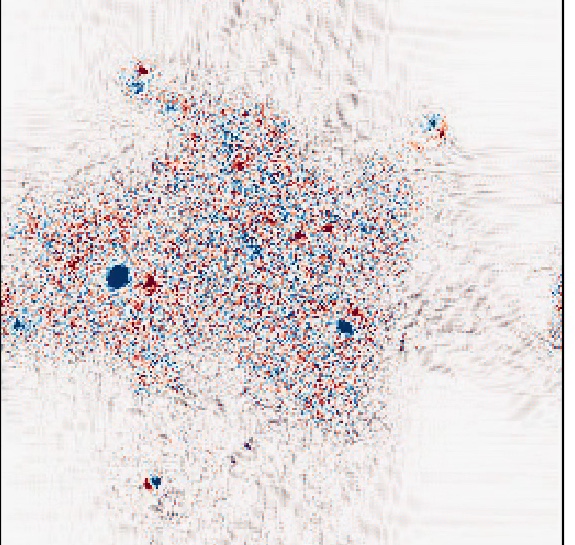
The question
In a fusion device, turbulence doesn't stay where it's driven — it spreads radially, carrying transport into regions that should be quiet. A clean way to study that is the simplest version of the problem: drop a localized patch of two-dimensional turbulence into still fluid and watch it relax. How fast does it grow, and what carries the growth?
The method
I run high-resolution simulations of the 2D Navier–Stokes equations in Dedalus, starting from an isolated vorticity patch, and track its enstrophy-weighted radius over time — Reff ∝ tα. The exponent α is the whole story.
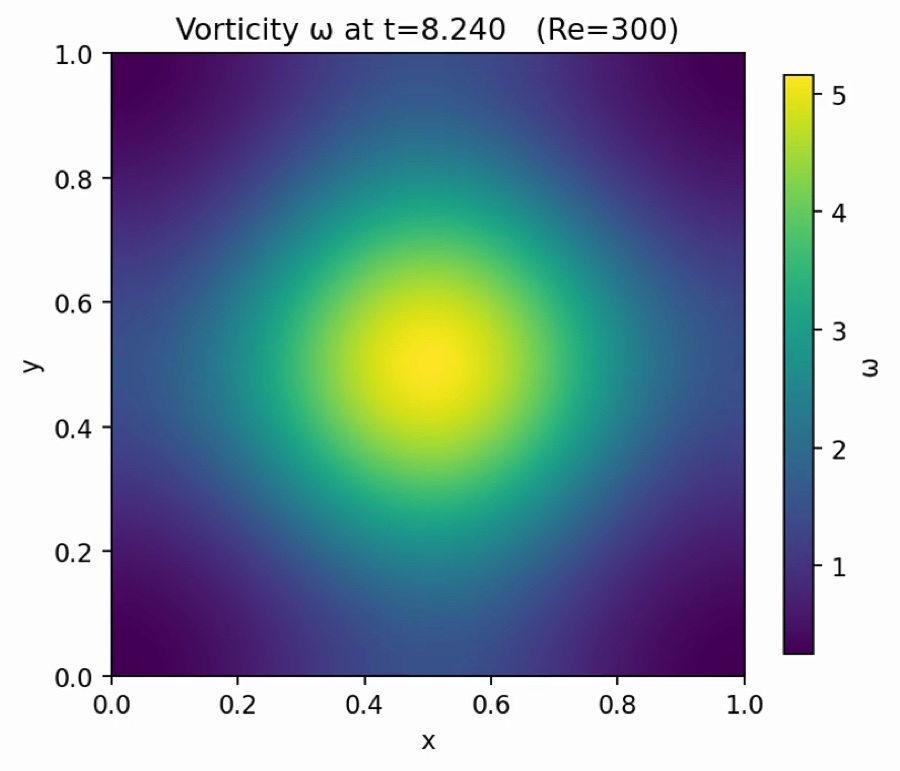
The spreading is subdiffusive — α < ½. That already says something: it's slower than ordinary diffusion (α = ½) and nowhere near ballistic, free-streaming growth (α = 1). Something is holding the patch back.
The picture: structure sets the rate
The exponent lands in one of two regimes, and each corresponds to a different kind of internal structure:
The "puff"
Coherent vortex dipoles survive and ferry vorticity outward in near-ballistic flights. Structure intact, faster growth.
The "spot"
The patch is shredded into an incoherent cloud of fine filaments that mix diffusively. Structure destroyed, slower growth.
So α is a readout of the patch's coherent structure — whether transport is carried by ballistic dipoles or an incoherent cloud. And I can select which regime happens with a single knob: the scale of an applied stirring relative to the patch. Small-scale forcing shreds the patch toward the spot (α → ¼); forcing at the patch's own scale preserves the dipoles and keeps the puff (α → ⅓).
Two lenses on the same result
The exponents fall out of two independent frameworks, which is part of why the picture is convincing:
- Conserved momentum invariants — a per-length impulse constraint gives the puff's ⅓, an angular-impulse constraint gives the spot's ¼.
- Nonlinear, density-dependent diffusion — treating the vorticity like a porous-medium (Barenblatt) diffusion with D ∝ ωm reproduces the same subdiffusive growth.
Toward plasma
The natural next step is to magnetize the problem: extend from neutral fluid to drift-wave turbulence (the Hasegawa–Mima and Hasegawa–Wakatani models), where a new player enters — the patch can radiate drift waves, and wave radiation competes with turbulent mixing to spread the enstrophy. That's the branch I'm building now with the fusion side of the project.
Why it matters
If the spreading rate is set by structure rather than by intensity alone, then models of turbulence spreading in confinement devices need to track more than an averaged intensity front — they need to know whether coherent eddies survive. That's the implication we're chasing.
Read the APS 2026 abstract (PDF) →This page summarizes work presented in the co-authored APS 2026 abstract. The figures here are generic illustrations from method-development runs; the full quantitative results and the paper will be linked once it's published.