A Self-Learning Trading System
I built an end-to-end automated trading-research platform — then used it to test whether simple strategies beat the market. They didn't. Here's the machine, and the honest result.
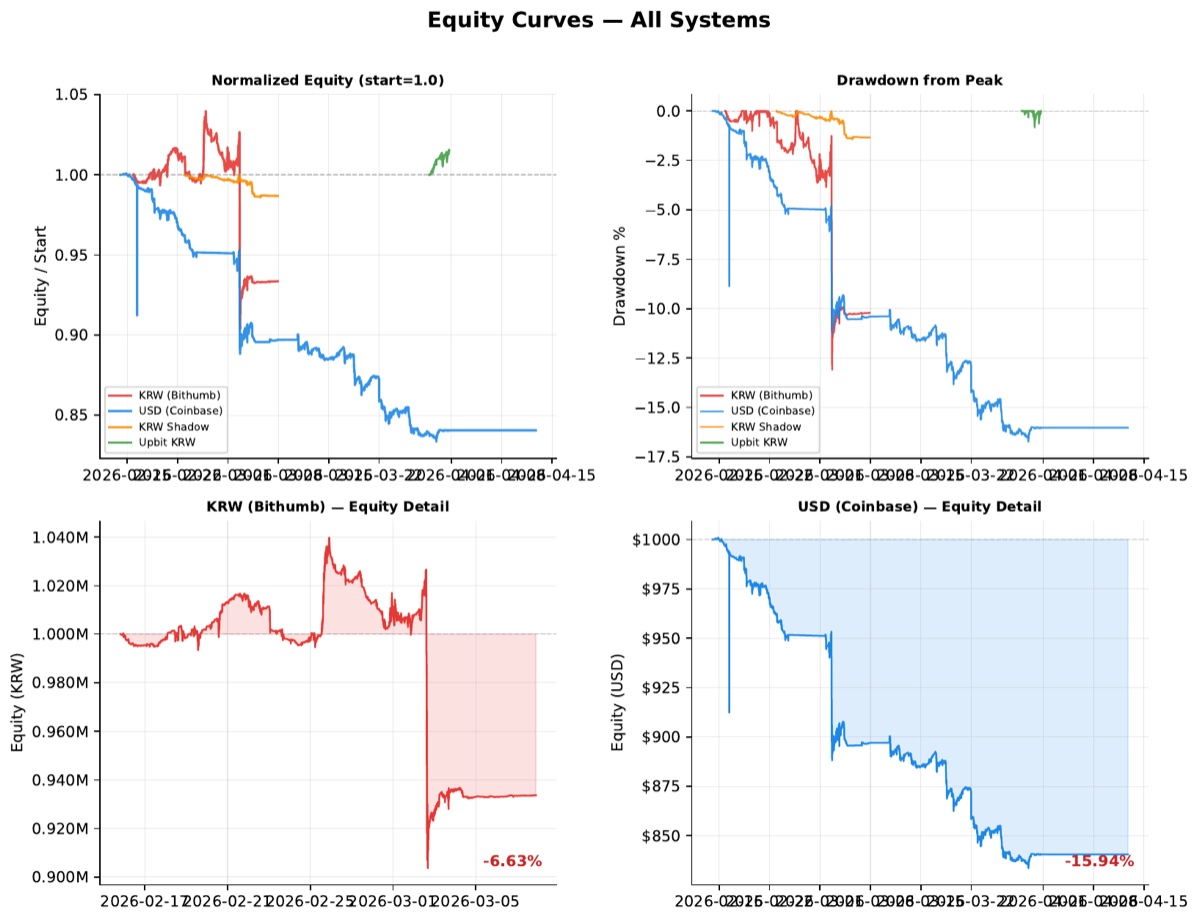
What this is (and isn't)
This isn't a profitable trading bot — and I won't pretend it is. It's a research platform I built to answer one question rigorously: can simple, systematic strategies beat the crypto market after real costs?
To answer it honestly I needed the whole apparatus — data pipelines, a backtester, a way to promote only strategies that survive out-of-sample, live micro-orders to feel real slippage, and monitoring to catch myself fooling myself. So I built that. Then I let it run on real exchanges at tiny size and read the results without flinching.
The machine
The system runs itself on a weekly cycle — strategies are discovered, tested, promoted, and demoted with almost no manual input:
- Discover & backtest. Each strategy is scaffolded, then walk-forward backtested on candle history. Gate 1: win rate ≥ 45%, Sharpe ≥ 0.5, max drawdown ≤ 30%, n ≥ 20 trades.
- Out-of-sample gate. Survivors are re-tested on the most recent 90 days they've never seen. Gate 2 is stricter (Sharpe ≥ 0.9, expectancy ≥ 0.2%/trade). Two windows must both pass — the guard against overfitting.
- Paper, then tiny live. Promoted strategies trade on real exchanges at ₩5K per position — small enough to be safe, real enough to pay true fees and slippage.
- Condition gate. Before every signal the system reads the market regime (trend, volatility, RSI) and skips strategies whose learned profile says "you lose in conditions like these" — but stays fail-open when the data is thin, so no loop ever goes silent.
- Health & auto-demote. Every six hours a health check watches equity, win rate, drawdown, and stuck positions; a kill-switch and auto-demotion pull any strategy that breaks its drawdown limit.
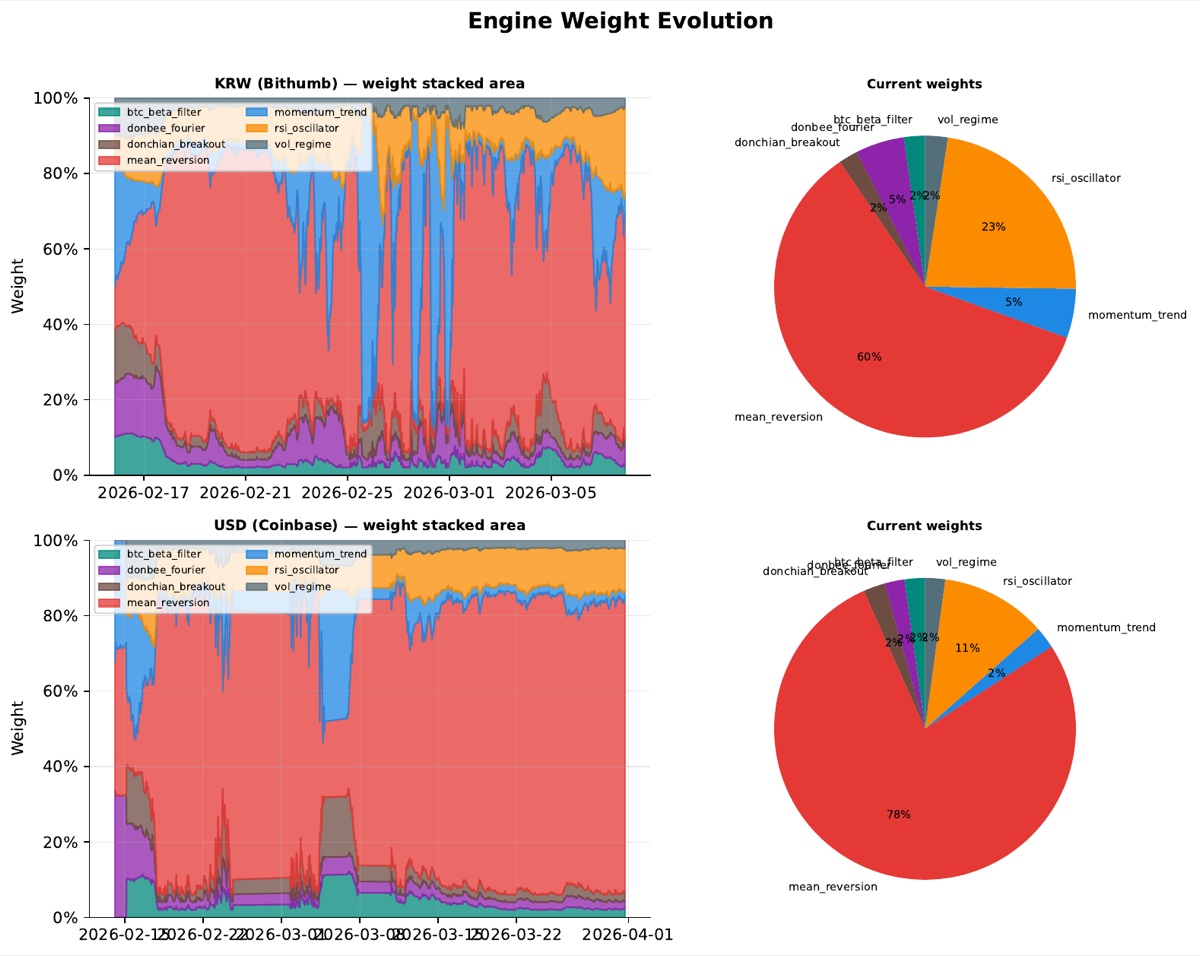
Under the hood: two exchanges, seven signal engines (mean-reversion, RSI, momentum, Donchian breakout, a Fourier method, a volatility-regime filter…), online weight adaptation that re-weights the engines from realized outcomes, and per-symbol risk limits. The engine weights don't sit still — they chase whatever's been working:
The result — and why
When I backtested every setup method I could think of across both exchanges, the verdict was blunt and consistent:
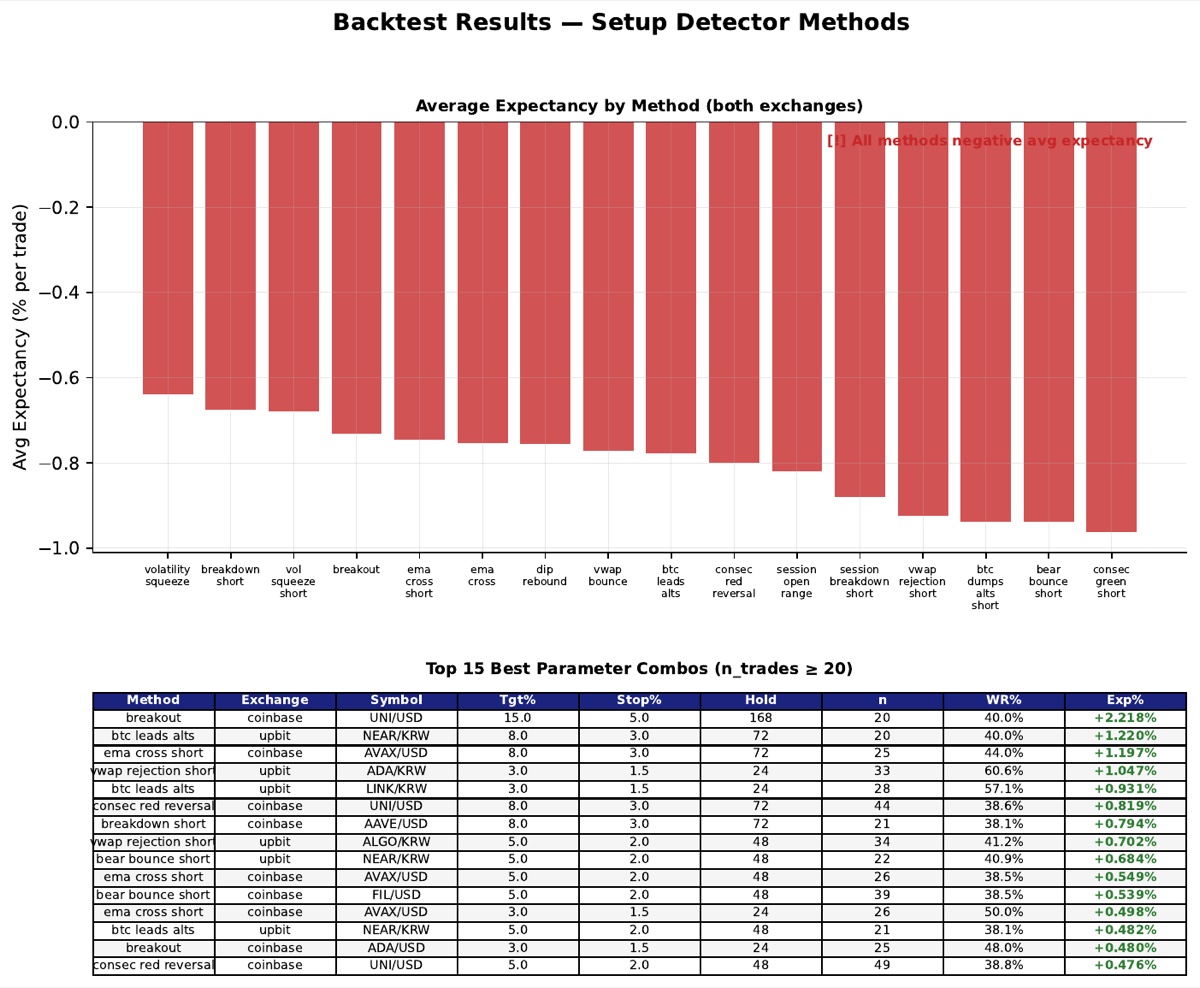
My own diagnosis of what went wrong — written before I knew I'd ever show it publicly:
- Mean-reversion over-weighting. Online learning let one engine dominate; it needed hard per-engine weight caps.
- Negative expectancy after costs. Sub-50% win rates plus real fees means long losing streaks in bad regimes.
- Over-trading. 346,000 analysis steps produced ~8,000 trades in 20 days — turnover that magnifies every cost. The fix was an event-driven loop that only acts on high-conviction setups.
- Fragile infrastructure. The Bithumb API changed format mid-run and killed the KRW loop — so I moved the primary market to Upbit.
What I took from it
The honest headline is that I didn't find a money-making strategy. But I don't think that's the failure it sounds like. Markets are close to a fair coin after costs, and most retail edges are noise — the valuable thing was building the machine rigorous enough to prove that to myself with data, instead of believing a pretty backtest and lighting real money on fire.
What I actually built is the part that transfers: a full research loop with honest out-of-sample gates, regime-aware risk control, and monitoring designed to catch self-deception. And I learned to report a clean negative result plainly — which, for anything I do next, matters more than a lucky curve ever would.
Read the full trading report (PDF) →